

Did you know the first car with a lane departure warning system hit the road over 30 years ago? The Mitsubishi Debonair introduced this pioneering safety feature in the early 1990s.
Today, this technology is a common guardian in modern vehicles. It watches the road’s markings to help prevent unintentional drifting.
Our team analyzes how this feature acts as a critical safety layer during your commute. It provides alerts when your vehicle begins to move out of its lane without a turn signal.
By examining its history, we highlight how this essential technology has evolved. The core mechanics involve cameras or sensors that monitor your position on the road.
We provide this comprehensive guide to ensure every driver understands how these systems function. Our mission is to help you feel confident using all your car’s protective features.
The Evolution and Importance of Lane Departure Warning Systems
Statistical evidence underscores the vital role this technology plays in saving lives on American highways. Its progression from an optional novelty to a common safeguard marks a significant advancement in automotive safety.
Brief History and Industry Adoption
The automotive industry’s commitment to this feature has grown steadily over decades. It represents a direct response to the need for better driver support.
- The first production car equipped with a departure warning was the Mitsubishi Debonair in the early 1990s.
- Mercedes-Benz later integrated this warning system into its Actros commercial trucks, enhancing safety for professional drivers.
- Today, these systems are standard or available in most new vehicles, reflecting widespread industry acceptance.
Impact on Driving Safety and Reduced Lane Departures
Research from 2015 revealed a sobering fact: 13,000 U.S. fatalities occurred due to vehicles drifting from their travel lane. This data highlights the critical need for the intervention this technology provides.
Our analysis confirms its effectiveness. Studies project that advanced lane departure prevention could cut single-vehicle accidents by 66.5% by 2045. Every alert is designed to combat fatigue and distraction, making it a fundamental layer of protection for everyone on the road.
Lane Departure Warning System Explained: Mechanisms and Components
At its core, this protective technology functions through a sophisticated network of sensors and cameras. We break down the key hardware and software that work together to monitor your car’s position.
Role of Sensors, Cameras, and Detection Technologies
A forward-facing camera is the primary eye. It continuously tracks painted lane lines on the road.
Sensors process data like steering angle and your vehicle’s dimensions. They calculate the exact moment a drift begins.
Global standards ensure reliability. The UNECE regulation for Automated Lane Keeping Systems was approved in June 2020.
Following this, the U.K. government published a detailed 45-page guide in 2021. It outlines safe implementation for these advanced features.
Integration with Lane Keeping Assist and Driver Input
This warning feature often works with lane keeping assist. Together, they create a more cohesive safety net.
When an unintentional lane departure is detected, an alert is sent. You may feel a vibration in the steering wheel or seat.
Drivers must maintain active control. These aids provide support but do not replace human input.
Key integration points include:
- Seamless data sharing between the camera and steering system.
- Alerts designed to prompt immediate driver correction.
- Steering support that activates only if the driver does not respond.
Understanding this interaction is crucial for safe and effective use on every trip.
Real-World Challenges and Conditions Affecting Lane Departure Warnings
Our expertise reveals that several common scenarios can challenge these protective features, requiring driver awareness. These technologies rely on clear visual data to function correctly.
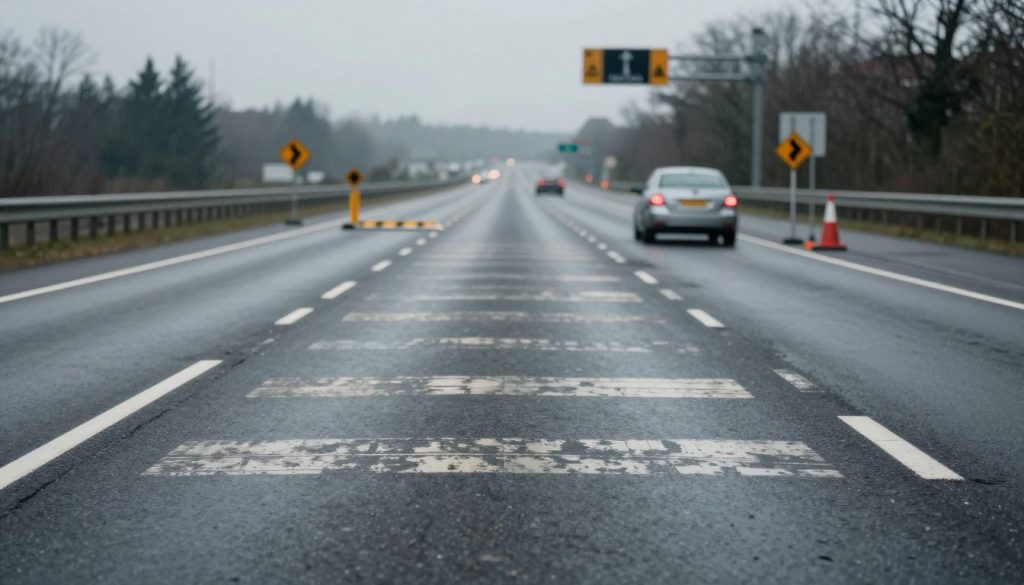
Issues with Faded or Obscured Lane Markings
The camera needs distinct lines to track your vehicle’s position. Snow, heavy dirt, or worn paint can hide these crucial markings.
When boundaries are invisible, the drift detection may not activate. You must remain fully attentive and in control during these times.
Adverse Weather and Curving Road Scenarios
Rain can create reflective puddles in tire tracks. The sensor may confuse these for actual lane lines, causing a false notification.
On winding roads, the forward-facing camera’s view can misjudge your path. It might think you are drifting even when centered.
Key situations where these safety features can be less effective include:
- Construction zones with temporary or conflicting paint.
- Sharp curves where the camera’s straight-ahead view is limited.
- Heavy fog or snow that obscures the road surface.
We advise drivers to be ready for manual override. Never rely solely on assistance systems in complex conditions.
Comparing Lane Departure Warning with Related Driver Assistance Technologies
Consumer feedback highlights a mix of appreciation and confusion regarding the different aids available in new models. Our analysis clarifies how these technologies interact and where they differ.
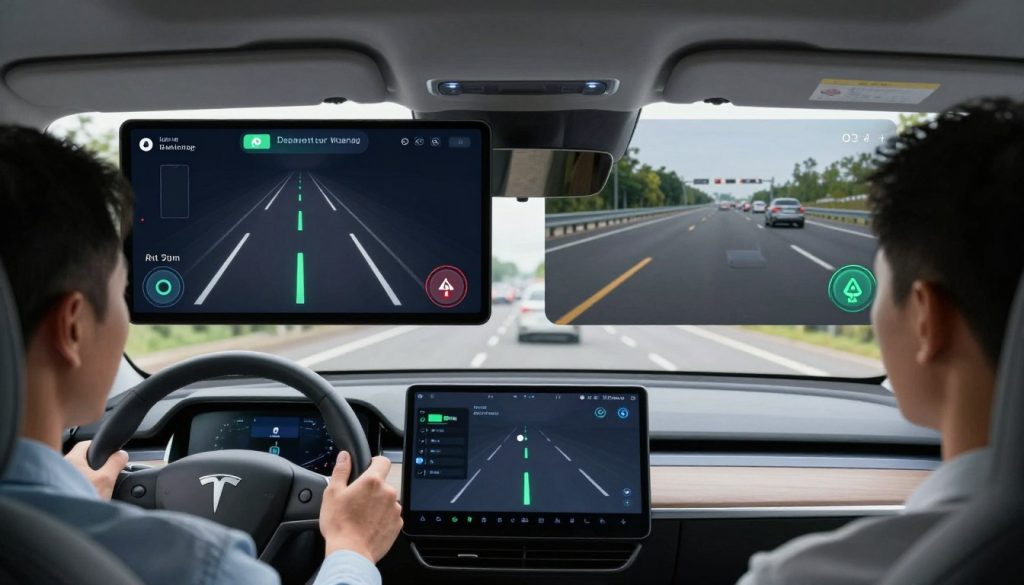
Differentiating LDW from Lane Keeping and Lane Centering Systems
It’s crucial to understand the distinct functions. A lane departure warning provides only an alert, like a vibration or sound.
Lane keeping assist adds gentle steering support to guide your car back. Lane centering assist actively works to keep the vehicle in the center of the lane.
This last feature is often activated by a button on the steering wheel. It usually requires adaptive cruise control to also be on.
User Experiences and Feedback Across Car Models
Owner satisfaction varies significantly. A survey of 47,000 vehicles by Consumer Reports found many drivers appreciate lane centering.
One 2020 Toyota Corolla owner praised it for reducing arm stress on long trips. Conversely, a 2020 Camry driver found their alert feature too sensitive during intentional changes.
The technology is designed to stay silent when your turn signal is used.
Technological Enhancements and Manufacturer Variations
Brands package these safety features differently. Acura, BMW, and Volvo offer distinct suites that combine alerts with other active protections.
Key enhancements include:
- More refined camera detection for faded road lines.
- Steering interventions that feel more natural to the driver.
- Integration with other assistance systems for seamless operation.
Understanding these variations helps you use your car’s full protective potential.
Ensuring Road Safety and Next Steps in Driver Assistance Innovation
Road safety is entering a new era. Advanced driver assistance systems work together to create a protective shield around your vehicle.
The market for traffic jam assistants is projected to reach $5.58 billion by 2028. These technologies use advanced lane keeping features.
We conclude these systems significantly enhance road safety. They are not a substitute for constant human vigilance behind the wheel.
Integration of lane departure warning with automated steering reduces stress on long trips. Our commitment involves providing accurate maintenance information for your car’s advanced assistance systems.
We encourage all drivers to stay informed. Understanding your vehicle’s capabilities contributes to a safer environment for everyone. Learn more about the future of these integrated advanced driver assistance systems.